Why is Bumper blind and deaf?
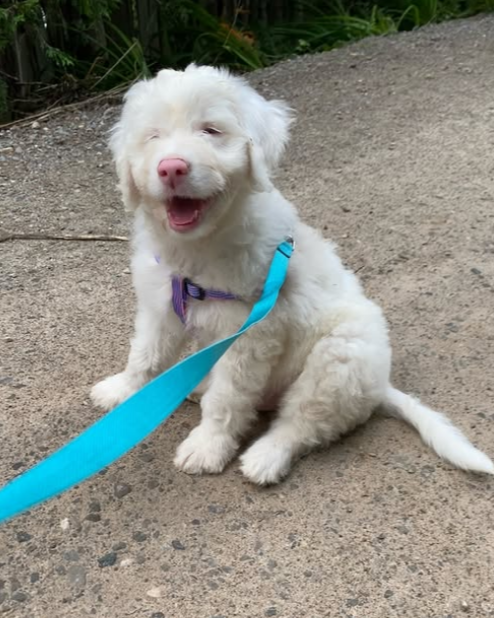
When we first met Bumper, he was eight weeks old and fast asleep.
We had been invited to visit a litter of puppies in our town and help socialize them before they went to their new homes. As soon as we arrived, all the puppies bounded over to investigate us, except for one little white puppy who remained asleep, completely unaware that anything had changed.
Once Bumper woke and realized we were there, he greeted us happily. Then he was off again, confidently exploring the world on his own terms.
We fell in love with him that day. We returned the next day, and then again the day after that. It was abundantly clear that we belonged with him.
Bumper was born blind and deaf because he is what is commonly called a double merle dog.
What does “merle” mean?
Merle is not a breed or even technically a colour. It is an inherited coat pattern that produces irregular areas of diluted and darker pigment. It can create the marbled grey, black, brown or reddish coats seen in breeds such as Australian Shepherds.
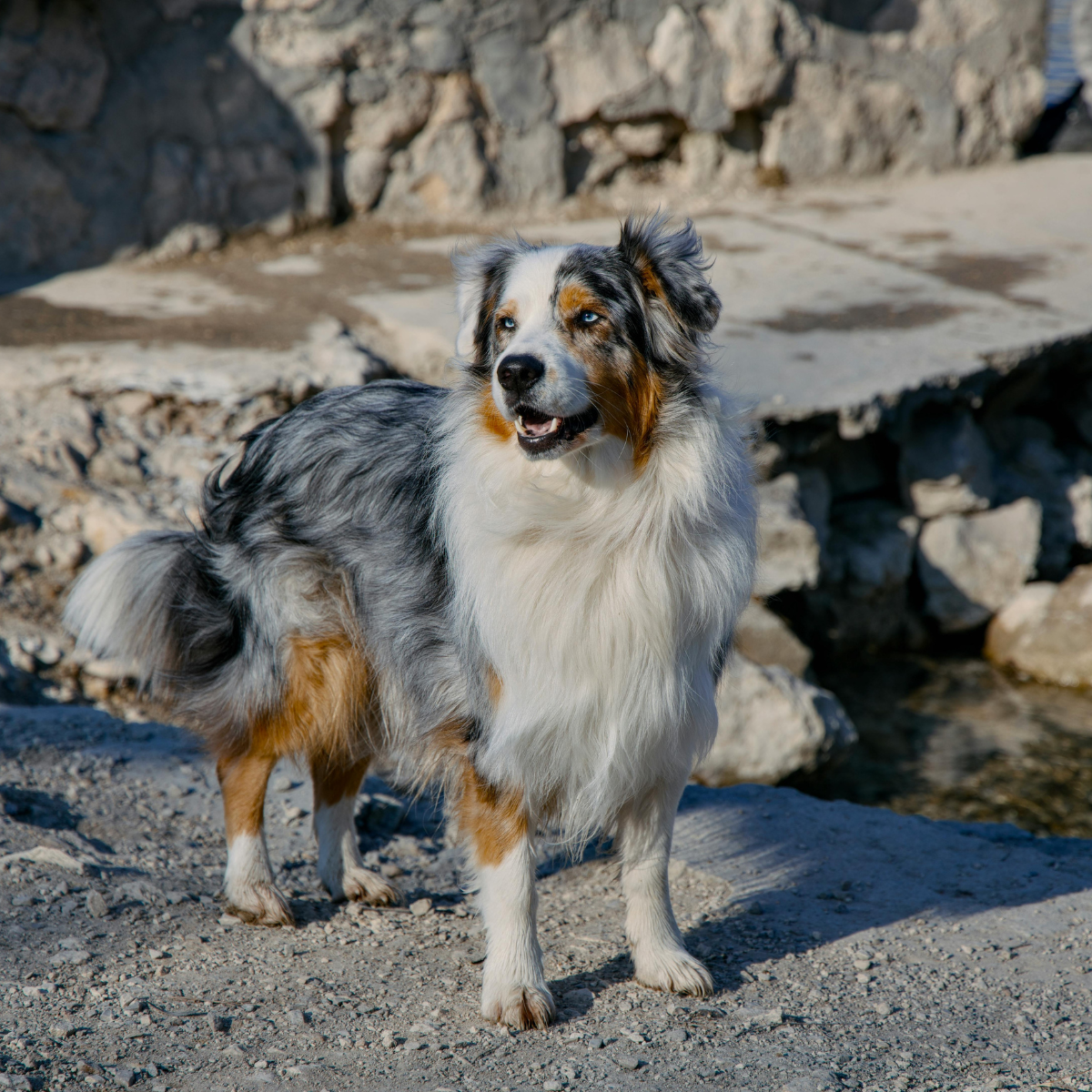
A dog only needs to inherit one merle variant to display the familiar pattern. Most dogs with one copy do not experience the severe sensory conditions associated with double merle.
The danger arises when two dogs carrying merle are bred together. Each puppy in that pairing has a chance of inheriting a merle variant from both parents. Puppies that inherit two copies are commonly called double merles.
These puppies are often predominantly white and face a substantially increased risk of being born deaf, visually impaired or both. Possible eye abnormalities include unusually small or improperly developed eyes, malformed pupils and abnormalities affecting structures inside the eye. The precise effects vary considerably: some double merle dogs have functional hearing and vision, some experience impairment in one sense, and others, like Bumper, are affected in both.
Merle is not always visible
Bumper’s mother was a merle Australian Shepherd. His father was a poodle who did not appear to have a merle coat.
However, merle genetics can be more complicated than appearance alone suggests. Some dogs carry a shortened or less visibly expressed merle variant, sometimes described as cryptic merle, and may show little or no obvious merle patterning. Patterning can also be subtle or hidden beneath other coat colours.
Without genetic testing, we cannot state exactly which variant Bumper’s father carried. However, if Bumper inherited two merle variants, his father must also have contributed one despite not visibly looking merle.
This is why responsible breeding cannot rely only on looking at the dogs. Genetic testing and a proper understanding of merle inheritance are especially important when merle may be present anywhere in a dog’s ancestry.
How double merle affects Bumper
Bumper is completely deaf. He does, however, notice vibrations created by certain sounds, including a dog’s bark or a sudden burst of laughter.
He also has several congenital eye abnormalities. He cannot see the world as most dogs do, but he appears to perceive some contrast between light and shadow. The video below explains his vision and eye conditions in greater detail.
Why we need to talk about breeding
Merle coats are extremely popular, and demand for the pattern has expanded beyond breeds in which it has traditionally occurred. Merle Australian Shepherd–poodle crosses, often called Aussiedoodles, are one example.
I am seeing what appears to be an increasing number of double-merle Aussiedoodles. Recently, three Aussiedoodle puppies arrived at my local animal shelter with varying degrees of blindness and deafness.
I do not share this to shame individual dogs, families or rescue organizations. Bumper is not a mistake, a tragedy or a cautionary object. He is an intelligent, joyful and adventurous dog whose life has tremendous value.
But loving the dogs who already exist does not require us to ignore preventable breeding practices.
Backyard breeding, poor genetic knowledge and the demand for fashionable colouring can have real consequences. Anyone intentionally producing merle dogs has a responsibility to understand the genetics, test breeding dogs and avoid pairings that could produce double merle puppies.
Prospective puppy families can also help by asking breeders whether merle is present in either dog’s lineage, what genetic testing has been completed and how the breeder ensures that two merle-carrying dogs are never paired.
Double merle does not define a dog’s future
It is important to discuss the risks of double merle breeding honestly. It is equally important not to suggest that existing double merle dogs are broken or incapable of enjoying life.
Bumper does not spend his days thinking about the senses he does not have. He works with the information available to him: scent, touch, vibration, air movement, texture, memory and the people he trusts.
He explores boldly. He solves problems. He plays. He gets himself into trouble. He makes choices, forms relationships and experiences the full range of emotions that any dog does.
Double merle breeding is preventable. Blindness and deafness can require thoughtful care and adaptation. But disabled dogs are not lesser dogs, and Bumper is not defined by what he cannot see or hear.
His world is different… not empty.
